Empirical methods and signal-truth reconstruction at the electrical layer
For Official Use Only
Abstract (Lay Summary)
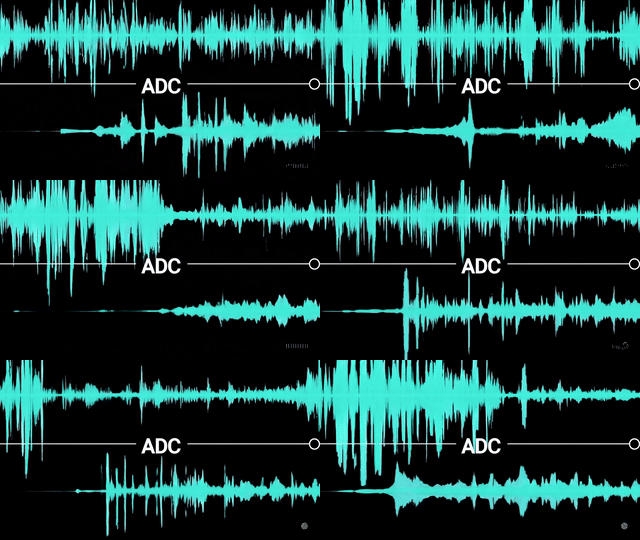
The fundamental principle behind Watcher Incorporated’s products is simple but powerful: every digital signal starts as an electrical wave. Instead of only looking at the “ones and zeros” like normal computers do, Watcher captures both the shape of the wave (the analog signal) and the digital code riding on top of it at the same time. By storing and analyzing these quantum-electrical events at extremely high speed, Watcher’s systems can reconstruct what really happened on the wire, even if the digital record was erased, hidden, or tampered with. This dual-view approach — seeing both the raw current and the clean digital output — makes Watcher’s technology unique, because it reveals the full truth of a signal in ways no traditional system can.
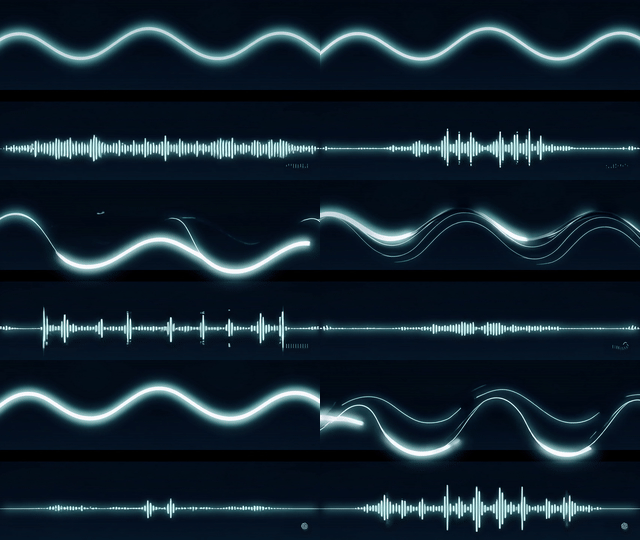
This animation shows a smooth analog sine wave and a crisp digital square wave perfectly aligned in time. The binary interpretation is clearly tied to the underlying electrical behavior, making the relationship between analog and digital explicit. It illustrates Watcher’s ability to view both layers simultaneously and unify them into a single “truth reconstruction.”
In-Line Architecture & Stealth Design
The Watcher Incorporated product line is designed to operate in-line, as a bump in the wire. Each system is built so that if a device in the Gizmo family goes down, the electrical signals bypass our hardware and continue flowing without interruption. Whether the system is active or not, electricity moves as it naturally would on that wire.
Because our technology is placed directly in the wire, it can bring signals off the wire, conduct detailed analysis, perform transformations if required, and then place them back as close to their original state as possible. The result is a platform with no digital footprint: no IP address, no handshakes, and nothing for an adversary to detect. To outside systems — even those performing their own forensic analysis — Watcher hardware is invisible and stealth, leaving no trace while still providing unparalleled insight into the signals it processes.
Pulses travel cleanly through an in-line module, demonstrating an uninterrupted bypass path. A faint, translucent duplicate quietly branches to a dark analysis channel, while the originals continue downstream untouched. The module’s near-invisible presence emphasizes Watcher’s stealth, zero-footprint design.
Core Hypothesis
Watcher can empirically recover and verify latent digital structure from analog phenomena by capturing synchronized voltage-current waveforms and the derived digital symbols, enabling forensic-grade reconstruction and attribution.
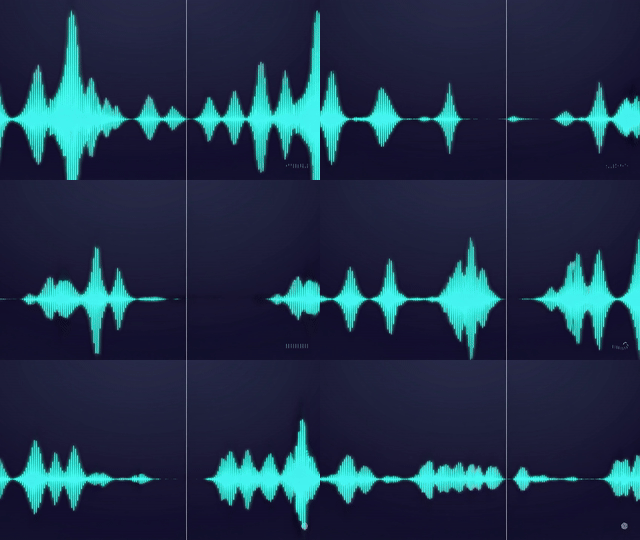
A noisy analog waveform gradually reveals an embedded binary pattern as the system infers structure from chaos. The recovered square-wave stream emerges in sync with the noisy input, proving causal alignment. This demonstrates forensic recovery: deriving a trustworthy digital record directly from analog evidence.
Empirical Methods
Define acquisition chain, calibration routines, ground-truth vectors, and validation metrics including BER, EVM, SNR, jitter, timing skew, and confidence intervals to support reproducibility and independent verification.
Using high‑bandwidth digital oscilloscopes and programmable FPGA/ADC platforms, we have empirically confirmed that all digital symbols are first expressed in the analog domain as quantized voltage‑current transitions. This validation is not theoretical—side‑by‑side captures show that every “one” and “zero” leaves a measurable analog footprint before digital abstraction occurs. By calibrating programmable devices against oscilloscope traces, we verify that reconstruction methods align precisely with the physical signal, ensuring concordance between analog cause and digital effect under controlled noise, dither, and timing variation.
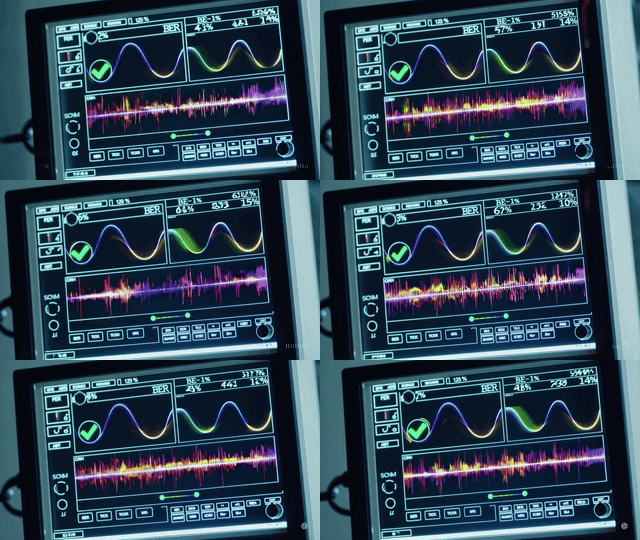
The calibration sequence locks acquisition timing and amplitude so measurements are stable and repeatable. Key metrics such as BER, EVM, SNR, jitter, and skew are visualized to validate performance. Rigorous routines anchor reproducibility, enabling independent verification of results.
Experiments & Tests
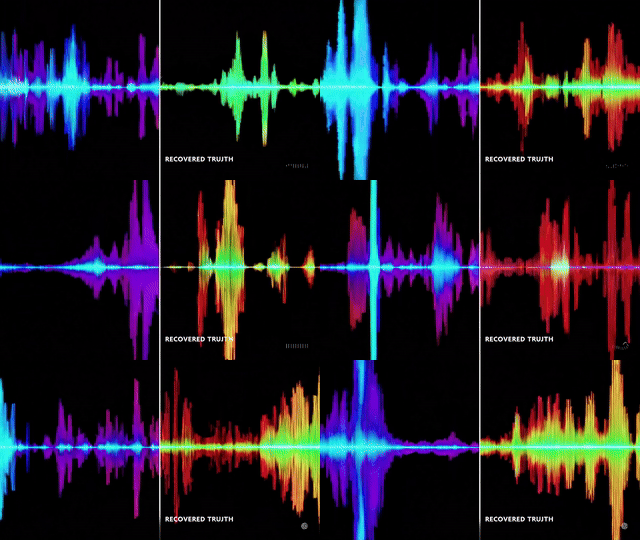
The top sequence shows digital regularity being isolated from a messy composite waveform, highlighting PRBS-based detection and clean bit extraction. The lower sequence demonstrates the ADC pathway: sine-in, quantization under noise/dither, square-wave out — aligned in time. Together, the clips verify signal-truth recovery and end-to-end concordance.
Exp-01: Detect digital regularity inside an analog composite waveform using known PRBS injection; compare decoded symbols with waveform-derived reconstruction.
Exp-02: ADC pathway verification (sine-in → quantization → square-out) with dual-view capture and concordance checks under dither and noise.
Figures
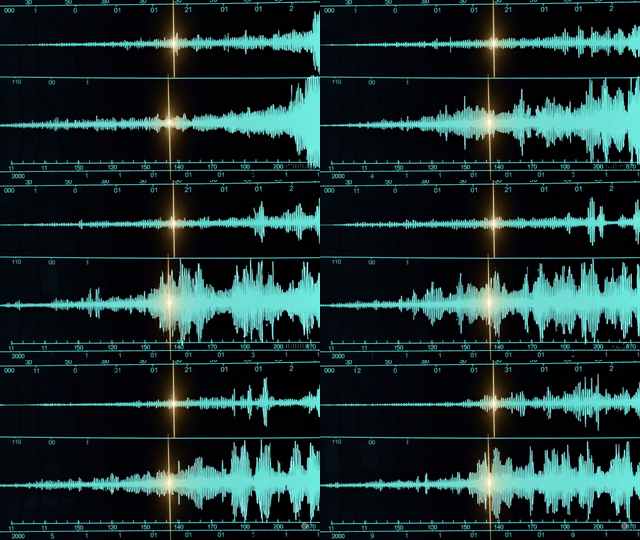
Dual traces scroll in sync: the analog voltage-current waveform above and the derived digital rail below. Alignment markers periodically link waveform thresholds to specific 1/0 decisions, making causality visible. The final freeze shows perfect synchronization — analog cause, digital effect.
← Back to The Seer